

Overview
The Other Side of Me is a Spatial Puzzle / Perspective-Switch Maze Game that transforms emotional experience into the form of an adventure.
Players are split into two selves, switching between the 2D physical reality and the 3D spiritual world and aiming to align both positions. By observing and navigating through mirrored environments, players are invited to heal the separation between body and soul through spatial exploration, turning alignment into both a puzzle to solve and a feeling to understand.
Key Features

Dual-Perspective Gameplay
(2D / 3D)
Players switch between a flat, symbolic 2D space and a grounded 3D environment, each representing different states of the self.

Convergence-Based Puzzle Design
Levels resolve only when both versions of the character reach the same convergence point simultaneously.
Emotional Healing Adventure
An introspective journey about fragmentation, vulnerability, and reconciliation, experienced through space and movement rather than dialogue.
Core Mechanics

Main Mechanics
Perspective Switching
Players alternate between the 3D spiritual world and the 2D reality world. Spiritual world is a first-person exploration in a surreal, emotionally-charged 3D space; Reality world is squeezed into a flat 2D space, where player only can move horizontal (left and right).
Spatial Overlap
Two separate spaces echo each other through shared spatial elements such as furniture, decoration. By navigating and each space independently, players deduce the spatial structure and align their positions.
Support Mechanics
Spatial Reasoning
Players interpret relationships between two separated worlds by observing environmental parallels, such as shared chair, desk, bed, etc.
Environmental Interactive
Vertical Navigation
Focuses on opening doors to reveal hidden spaces, symbolizing the player’s regained control of partial body and the new emotional challenge of facing the unknown.
The ability of going upstairs and downstairs, which Symbolizes the extension of perception and emotional growth. It alludes the player’s gradual openness and the reunion of body and spirit.

Story Summary
Shattered by suppressed emotions, Lena becomes split between a 2D mirrored body and a 3D spiritual self. She travels through the Wilderness of Depression, the Floating Islands of Anxiety, and the Fortress of Fear. Each landscape mirrors the roots of her inner conflict from the reality. As her soul uncovers clarity, her trapped body regains the ability to move. Reuniting the two selves becomes an act of acceptance, allowing Lena to return to the world whole.
Narrative Design
Themes

Dissociation
Emotional detachment from oneself, where body and soul exist in separate realms that mirror but never fully connect.

Adventure
Facing inner struggles, unseen realities, the buried pain and silent conflict within deep emotions.

Healing
The process of recognizing, confronting, and understanding inner feelings instead of suppressing or ignoring them.
Narrative Focus
Prologue: Split of Two
Introduces the detachment and the symbolism of 2D physical world and 3D spiritual world, as well as set up the goal of alignment.
Comics
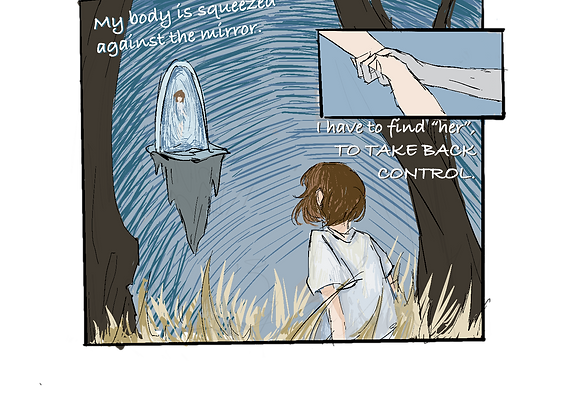
Lena soul and body are spitted into two worlds. Her soul needs to find her body that is stuck in the mirror, achieving alignment.
Level1: Depression
This level deconstructs the quiet devastation of depression born from displacement and routine. It explores how a physical departure from past life (home) can trigger an emotional departure from the self and others.

Level2: Anxiety
This level describes the anxiety of future. Set in an art gallery that displays Lena’s work, it explores how being observed, peer competition and uncertainty about the future merge into a silent pressure to stay relevant.
Level3: Fear
This level visualizes the fear of adulthood — the emotional tension between growth and loss. 2D and 3D spaces intertwines fragments of her childhood and adult life, showing how maturity demands the reconciliation of who she was and who she has become.
Comics
Two worlds are overlapping. Lena comes back to the reality and awakes in front of the table. In front of her, bright sunlight shines.
Endings: Back to Reality
This final section represents Lena’s emotional recovery and return to reality, which signifies her reconciliation between body and soul. Light fills with the whole room as Lena steps out of her fragmented inner world, symbolizing acceptance and emotional maturity.


Level Design
Level 1: Depression
Objective: Navigate the environment to gather film clips using different interaction methods.
Progression: Moderate-high complexity, 7 video clips with three collecting ways. Players must observe, react, and align timing/space to retrieve all fragments.

Level 2: Anxiety
Objective: Use shape-matching montage UI to reorder clips and generate an emotionally transformed sequence via “editing the day”.
Progression: Moderate complexity. 7 timeline slots with fixed shapes. Player selects 7 out of 13 clips, arranging them to activate one of several montage-based ending states.

Level 3: Fear
Objective: Use shape-matching montage UI to reorder clips and generate an emotionally transformed sequence via “editing the day”.
Progression: Moderate complexity. 7 timeline slots with fixed shapes. Player selects 7 out of 13 clips, arranging them to activate one of several montage-based ending states.

Design Process
This story is inspired by my personal experience in the spring of 2025, when I faced the uncertainty of graduation, work, and life abroad. Overwhelmed by pressure and emotional isolation, I struggled with sleepless nights and often found myself crying for no reason. I realized that my thoughts could no longer control my emotions, and instead, my emotions had taken over my body.
This game is my fight back, portraying the adventure of confronting emotional barriers and navigating through personal conflict. Through its mechanics, players embark on a journey to uncover, confront, and reconcile the fractured parts of the self, symbolizing how we must face our inner struggles head-on in an uncertain world.
Why This Game
Initial Concept: Inspired by my personal experience of overwhelming anxiety in Spring 2025, I decide to create an emotional healing journey by the perspective-switching mechanic and a spatial maze adventure.
Game design: Designed three interconnected levels with increasing emotional intensity and spatial complexity to mirror Lena’s psychological recovery.
Prototype: Built the initial prototype to test core mechanics and refine gameplay concepts.
Art creation: After finalizing the level design, creating and refining the scene, beginning/ending comics and UI art to ensure visuals support both narrative and mechanics.
Programming refinement: based on the scenes, implementing the door and stair mechanics.
Playtesting and Iteration: Conducted self-tests and invited peers for feedback, repeatedly improving the game’s mechanics, pacing, and emotional resonance.